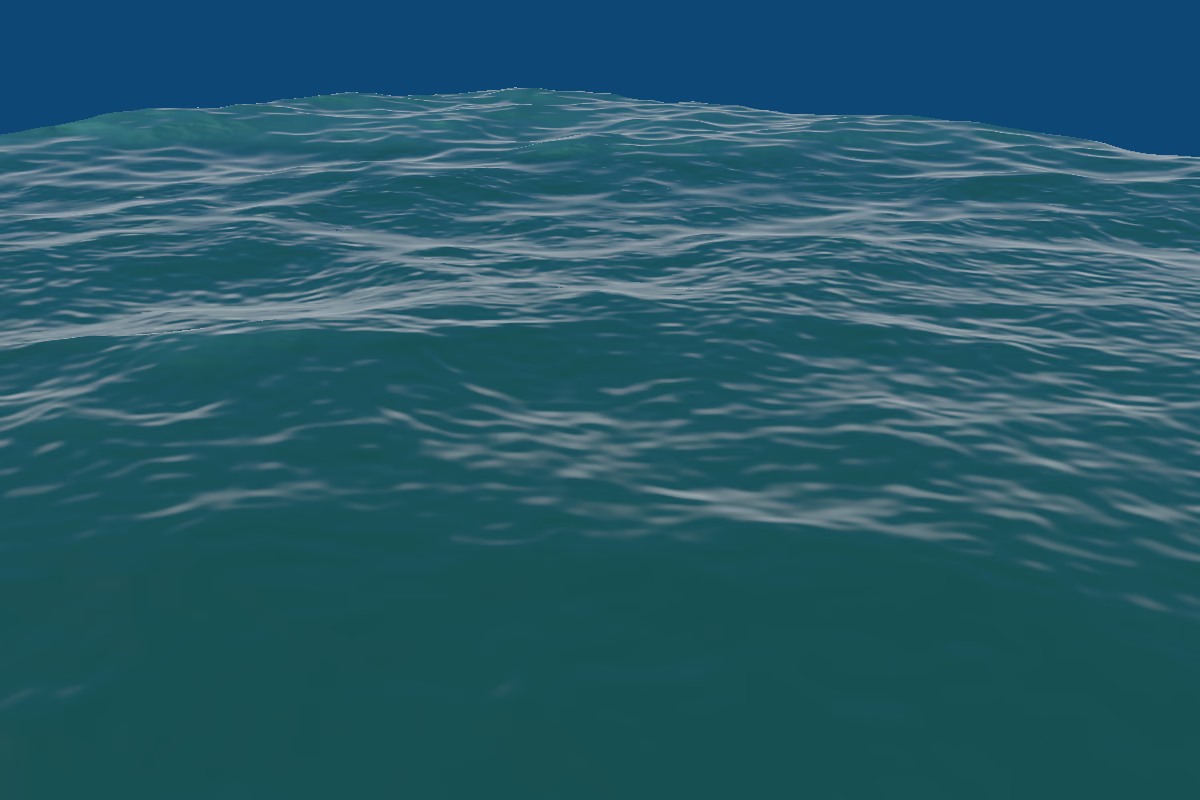
Generated wave-seed asset preview

Spectral Ocean

Build broad-band offshore procedural oceans in Three.js r185 WebGPU/TSL using dimensioned directional spectra, compute FFT cascades, StorageTexture ping-pongs, exact spectral derivatives, displaced-surface Jacobians, transported foam, water optics, CPU query bounds, falsifiable GPU evidence, and phase-resolved or phase-averaged handoff to a separate bathymetry-aware coastal owner.

$threejs-spectral-ocean 1 primary implementation 1 flagship 1 secondary surface native evidence pending Latest skill update commit 9077075 ↗ SKILL.md on GitHub ↗ raw (for agents) ↗

Primary implementation surface

These routes are generated from canonical source. Their exact status remains separate from implementation availability.

The approach, mathematically

The ocean surface is synthesized in the frequency domain (Tessendorf). A directional spectrum seeds complex amplitudes, which are evolved analytically and inverse-FFT'd per frame:

$$\tilde h(\mathbf k, t) = \tilde h_0(\mathbf k)\,e^{i\omega(k)t} + \tilde h_0^*(-\mathbf k)\,e^{-i\omega(k)t}$$

The conjugate pairing enforces $\tilde h(-\mathbf k,t) = \tilde h^*(\mathbf k,t)$, so the spatial height field is real. Dispersion uses the finite-depth gravity–capillary relation — the capillary term matters at the top of the finest cascade:

$$\omega^2 = \left(gk + \tfrac{\sigma}{\rho}k^3\right)\tanh(kh)$$

Choppy displacement is the horizontal gradient field $\hat{\mathbf D}(\mathbf k) = i\,(\mathbf k/k)\,\hat h(\mathbf k)$; whitecaps trigger where the deformation Jacobian folds the surface:

$$J = (1+\lambda\,\partial_x D_x)(1+\lambda\,\partial_z D_z) - (\lambda\,\partial_x D_z)^2 \;<\; J_{\min}$$

Because $\mathbf D$ derives from one scalar spectrum, $\partial_z D_x \equiv \partial_x D_z$ and the single cross term is exact. Multiple cascades cover wavelength bands with half-open masks $[k_{lo}, k_{hi})$ to avoid double-counting energy at handoffs.

Preview and evidence ledger

Every image identifies what it proves. Page screenshots demonstrate the published presentation only; generated inputs demonstrate asset channels only; canonical acceptance still requires render-target readback and a schema-v2 bundle.

Canonical runtime evidence pending4 published images

The full skill

The complete SKILL.md as loaded by agents — verbatim, rendered.

Spectral Ocean

Use this skill when a large, unbounded-looking water surface must span several wavelength scales with directional wind sea or swell. The canonical state is a sampled random field in wavevector space, evolved by dispersion and transformed on the GPU. It assumes a horizontally homogeneous, periodic patch with one dispersion relation per cascade. It is not a coastline, bathymetry, inundation, or obstacle-flow solver. Use $threejs-water-optics for bounded interaction grids, coastal coupling, or a small authored wave set.

Read references/spectral-cascade-ocean-system.md before implementation or review. For any island, coast, shoal, reef, harbor, or moving waterline, also read the coastal archipelago contract. All physics-frame, clock, provider, interaction, residency, state-version, and presentation boundaries come from the shared physics-domain and interaction contract. The FFT remains a domain solver behind those interfaces; it does not define a parallel water-query schema.

Ocean optics consumes the same typed LightingTransportSnapshot as the sky and coastal owner. Solar-disc, sky-radiance/irradiance, segment-transmittance, cloud, visibility, and water-extinction factors retain distinct quantity/unit/ basis and factor identities so no attenuation or direct disc is applied twice. Radiometry is a provider boundary, not an InteractionRecord.

Numeric Provenance

Every quantitative statement uses one tag:

  • [D] Derived from equations, dimensions, formats, or reproducible counts;
  • [G] Gated as a predeclared pass/fail limit;
  • [M] Measured on a named device, viewport, and workload;
  • [A] Authored as a visual/application input.

Unlabelled integers inside exact equations, tensor dimensions, byte identities, and API names are [D]. Resolutions, patch lengths, sea-state constants, thresholds, format choices, timings, and memory limits must be tagged.

Algorithm Gate

Choose FFT cascades only when the visible band contains enough independent modes that direct summation is more expensive or visibly repetitive. The decision variables are visible wavelength interval, directional statistics, periodic-repeat distance, tolerated phase/slope error, interaction needs, and sustained storage bandwidth.

Requirement Algorithm Boundary
Few art-directed modes or exact cheap CPU queries Parametric waves in $threejs-water-optics Cost grows with component count.
Bounded disturbances Compute heightfield in $threejs-water-optics CFL and domain-boundary error.
Broad stochastic directional sea Multi-cascade FFT Periodic patches, spectral quadrature, FFT precision.
Spatially varying depth; phase-resolved shoaling/refraction matters Coastal dispersive or phase-resolving solver selected by $threejs-water-optics Local depth, boundary, and breaking-model error; FFT is only the offshore forcing.
Wet/dry fronts, run-up, bores, or hydraulic jumps matter Positivity-preserving depth-averaged coastal solver selected by $threejs-water-optics Conservation, wet/dry, and numerical-dissipation error; a heightfield or FFT is invalid.
Shoreline motion is sub-pixel and only wave statistics matter Phase-averaged wave-action transport plus analytic display bands No instantaneous phase contract; validate action/energy and image error.

Do not disguise scrolling normals or a wave pile as a low FFT tier.

Environmental forcing adapter

A wind-sea preset consumes the shared EnvironmentForcingSnapshot through an explicit spectral-forcing adapter. It does not feed instantaneous air velocity directly into a spectrum. The adapter records the sampled wind vector and reference height, surface roughness/drag or another calibrated vertical-profile model, atmospheric stability treatment, averaging window, spatial footprint, fetch geometry, forcing duration/age, directional spreading model, and the source-term family represented. It derives a calibrated U10 (or declares a different named reference-height input), peak/fetch parameters, and spectral direction in one physics frame with propagated version/error.

The input channel is the snapshot's footprint/filter-bearing airVelocityMps; air density/pressure/temperature/stability channels remain absent unless the selected adapter actually requires and receives them. PhysicsGraph latches the forcing version at sample-forcing for a declared interval. Spectrum/coefficient evolution never samples render time or a mutable weather uniform independently.

Gust-scale forcing may modulate spray or shading, but it cannot reseed a mature wave spectrum every frame. A stationary FFT sea freezes a documented forcing snapshot/statistical state; an evolving sea advances a validated action/energy source balance and preserves phase/coefficient continuity. Mean water current remains a separate water channel and Doppler term—it is never substituted for wind, and wind is never exposed as materialCurrentVelocityMps.

Offshore/coastal handoff

A spatially varying bottom destroys the global Fourier diagonalization used by the FFT. The spectral patch cannot, without a different solver, produce bathymetric refraction, shoaling, depth-induced breaking, diffraction around islands, reflection from cliffs, porous-reef loss, wave setup, run-up, or wetting/drying. Do not fade an unchanged deep-water FFT through the beach and label the result coastal simulation.

Choose exactly one handoff semantics:

  • Phase-resolved. At an offshore coupling curve, evaluate the same seeded spectral coefficients into surface elevation eta_b in metres and depth-integrated wave-discharge perturbation q'_b in square metres per second [D]; mean-current discharge remains a separate signal. For a matching finite-depth Airy mode, q'_hat=(omega_int/|k|^2) k eta_hat [D], from linearized continuity -i omega_int eta_hat+i k dot q'_hat=0 [D]. With uniform current, omega_abs=omega_int+k dot U [D]: intrinsic frequency owns orbital flux; absolute frequency owns the shared phase clock. The coastal boundary injects only the incoming characteristic and retains the outgoing one. Record phase, elevation, discharge, and reflected-wave residuals [M].
  • Phase-averaged. Convert height-variance density P_eta(k) to physical wavevector energy density E(k)=[rho g+sigma_surface |k|^2]P_eta(k), where sigma_surface is surface tension, and transport wave action N=E/omega_int when currents vary [D]. Transfer N, intrinsic frequency, group velocity, mean current, and dimensioned band quadrature. The near-shore model owns refraction, shoaling, breaking loss, and local phase synthesis. It makes no instantaneous phase-parity claim. Record incoming, dissipated, reflected, and transmitted band energy/action in one unit convention [M].

A one-way FFT donor cannot display coastal reflection that propagates back through the coupling curve. If that outgoing field is observable, extend the phase-resolving domain or implement an explicit two-way modal projection with phase, energy, localization, and periodic-copy residuals [G,M]. An absorbing layer is valid only when the rejected reflection is below its gate.

Both modes use one PhysicsContext, stable SI physics frame, water datum, bathymetry convention, seed or band identity, canonical PhysicsInstant samples, and PhysicsTimeInterval transfers from registered clock mappings. They do not introduce an independent monotonic timebase. A current U changes absolute frequency by k dot U [D]; if U varies materially within a periodic patch, route that region out of the FFT instead of freezing an inconsistent dispersion.

The offshore/coastal handoff also carries the canonical WaterSurfaceProvider envelope for every instantaneous query: mandatory freeSurfacePoint, freeSurfaceNormal, geometricNormalVelocityMps, and the exact WaterSurfaceParameterization, with optional fixed-parameterization surfacePointVelocityMps, material materialCurrentVelocityMps, and only the other channels actually represented. Descriptor, requested/actual PhysicsInstant, footprint/filter, frame/origin/transform, state/resource version, validity/error, latency, and residency cross unchanged. A phase-averaged handoff needs a separately owned display-phase synthesis before it can satisfy this instantaneous provider ABI.

Partition ownership in every transition band. Only disjoint Fourier bins or fields proven to have zero cross-covariance may use power windows that sum to one [D,G] and square-root amplitude weights. Coherent offshore/coastal copies have a covariance cross-term: a phase-resolved wave crosses the coupling curve at full amplitude and has one spatial render owner. If a render-only spatial blend is unavoidable, its coherent amplitude weights sum to one and displacement, tangents, normals, and velocity come from the same phase-matched composite field, including blend-weight gradients. Independently lerping final normals or adding both foam histories violates parity.

Foam crosses the handoff as one versioned provider signal. Its complete PhysicsSignalDescriptor identifies context, frame, physics-origin epoch, transform revision, footprint/filter, cadence/latency/residency, state/resource generation, validity, and per-channel error; canonical channels carry coverage, carrier velocity, source rate, diffusion, and decay state at sampleInstant: PhysicsInstant, with each source-rate channel declaring its actual sampling interval. Attribute whitecap and depth-breaking dissipation to exactly one owner, combine the disjoint dissipation terms, then map them once into one foam source/history. Never partition or saturated-add evolved coverage histories. A coordinate/atlas ownership change uses a declared conservative state map with remap/clamp/lost- coverage evidence, not a second independent-seconds foam tuple.

Pinned Three.js r185 Architecture

The API contract is verified against installed three@0.185.1 [G]:

  • WebGPURenderer, RenderPipeline, StorageTexture, and node materials come from three/webgpu; TSL comes from three/tsl.
  • Initialize before checking renderer.backend.isWebGPUBackend, device limits, or renderer.hasFeature().
  • Build compute with Fn(...).compute(...). After initialization, renderer.compute(nodeOrArray) records ordered dispatches. computeAsync() is initialization-safe but is not a GPU-completion fence.
  • StorageTexture simulation data uses NoColorSpace, no generated mipmaps, and explicit HalfFloatType or FloatType selected by validation.
  • Gate each kernel against the initialized device's maxStorageTexturesPerShaderStage and compiled binding layout. The reference fused physical assembly requires seven storage-texture bindings; use its ordered split path with at most three per dispatch on portable four-binding targets. Never allocate or compile the fused path before this gate.
  • Use pass(), optional mrt(), and one RenderPipeline; use PassNode.setResolutionScale(). Use exactly one output transform.
const renderer = new WebGPURenderer( { antialias: false } );
await renderer.init();

if ( renderer.backend.isWebGPUBackend !== true ) {
  throw new Error( 'WebGPU is required for the spectral ocean.' );
}

renderer.compute( orderedOceanNodes );
pipeline.render();

In a coupled route, every coefficient, transform, assembly, coastal-boundary, and source dispatch that advances physical water state executes inside a declared PhysicsGraphStage with exact interval and versioned dependencies. The render loop consumes the sealed presentation state; it does not advance the FFT/coastal solver, resample mutable forcing, apply runoff, or inject a private disturbance step.

Non-Negotiable Numerical Contract

Spectrum dimensions and cascades

Start from a directional angular-frequency variance density S_omega(omega,theta) with units m^2 s [D], normalized directional distribution, and finite-depth capillary-gravity dispersion. Convert it to the two-dimensional wavevector density

P(k_x,k_z) = S_omega(omega(k),theta)
             |d omega/d k| / k,        [P] = m^4.              [D]

Discrete coefficient variance includes Delta k_x Delta k_z [D]. A missing Jacobian, cell area, or Gaussian normalization invalidates sea-state amplitude.

Cascade power windows must satisfy sum_i w_i(k)=1 over the represented band [D,G]. Hard half-open bands are valid; smooth overlap uses amplitude sqrt(w_i) so expected power is not doubled. Each cascade declares patch length, grid spacing in k, isotropic upper cutoff, and repeat distance.

Transform convention

Write the transform pair in code and tests. This skill uses the unnormalized inverse convention

f[j] = sum_n F[n] exp(+i 2 pi n dot j / N).                     [D]

With this convention a unit DC coefficient produces a unit constant field. Any normalized IFFT must rescale initial coefficients consistently. Never tune spectrum amplitude around an undocumented FFT scale.

Pack the eight real fields required for height, horizontal displacement, slopes, and horizontal derivatives into four complex transforms, preferably as two complex lanes in each of two RGBA textures [D]. Validate the algebra G=A+iB, not component interleaving.

Hermitian and Nyquist rules

The evolved height spectrum must satisfy H(-k)=conjugate(H(k)) [D]. DC and self-conjugate Nyquist cells are real. Derivative multipliers receive parity-specific masks:

  • fields odd in k_x are zero on the k_x Nyquist line;
  • fields odd in k_z are zero on the k_z Nyquist line;
  • the mixed derivative is zero on either Nyquist line;
  • even second derivatives need no blanket Nyquist removal, but the final spectrum must still pass Hermitian projection and imaginary-leakage gates.

Zero k=0 before every division by |k|. Do not multiply a singular result by a zero mask and call it safe.

Exact choppy geometry

For the declared inverse-transform sign, choose the horizontal displacement sign by a one-mode test. This skill defines positive choppiness chi so h=a cos(kx) maps to X=x-chi a sin(kx), compressing the crest [D].

Sum displacement and derivatives across cascades before forming the horizontal Jacobian. For

P(q) = (q_x + chi D_x, h, q_z + chi D_z),

compute P_qx, P_qz, the determinant, and normalize(cross(P_qz,P_qx)) exactly. Do not divide each height slope by only its same-axis stretch; that omits cross coupling. A nonpositive determinant is a fold, not a normal-map detail.

Foam state

Compression may source foam, but a thresholded Jacobian is not persistent foam. Use a bounded, timestep-correct source/decay update and declare whether the history lives in Lagrangian parameter coordinates or is advected in an Eulerian/stable-physics-frame atlas. Include transport, dissipation, and source terms in diagnostics. Display thresholding is separate from state evolution.

CPU Coupling And Canonical Water Provider

Expose parametric sampling separately from physics-horizontal sampling. A dominant-bin CPU sum approximates the same seeded coefficients and dispersion; its omitted-coefficient triangle bound applies at fixed parameter coordinate. When choppy horizontal displacement is nonzero, a physics-frame (x,z) query must also invert the horizontal map. The reference derives the additional inversion error and the condition under which it is bounded.

The raw numerical sampler may return its solver-specific diagnostics:

{
  height,
  normal,
  horizontalResidual,
  omittedCoefficientBound,
  numericalErrorMeasured,
  status,
}

The omitted bound [D], solver tolerance [G], and GPU-versus-CPU probe error [M] are distinct fields. A public physics consumer never receives that raw shape. The spectral adapter publishes the canonical WaterSurfaceProvider sample in physics-frame metres: freeSurfacePoint, freeSurfaceNormal, geometricNormalVelocityMps, its exact WaterSurfaceParameterization, optional fixed-coordinate surfacePointVelocityMps, optional materialCurrentVelocityMps, optional waterColumnDepthMeters and densityKgPerM3. Each named channel is a complete shared SampledChannel; the parameterization remains its own exact canonical record. The result returns the complete shared PhysicsSignalDescriptor, bundle sampleInstant, and each channel's actualPhysicsTime resolving to a PhysicsInstant. The requested PhysicsInstant remains distinct from those returned actual instants and may differ only within declared latency/staleness gates. Unrepresented current, depth, or density channels are absent under missingChannelPolicy, not zero. The adapter composes coefficient omission, horizontal inversion, floating-point, transform/probe, filtering, and latency error without collapsing them into a false scalar certainty. Do not read the full FFT maps back in the frame path. The remaining canonical optional channels—material acceleration, pressure, bathymetry point, and wet/dry state—are likewise absent unless a named model supplies each with actual support and error.

surfacePointVelocityMps is a physical polar vector bound to the serialized surface gauge; only its normal projection is geometric. Whenever that optional vector is present, the exact identity is geometricNormalVelocityMps = dot(surfacePointVelocityMps, freeSurfaceNormal) at the same actual time, support/filter, and state version; its channel propagates correlated vector/normal error. The scalar normal speed is gauge invariant and remains a mandatory publication even when a reduced/implicit owner cannot publish the full fixed-coordinate vector. The material-current vector is independent of that parameterization. Both vector channels are in physicsFrameId, not moving-frame coordinate rates. Cross-frame transport rotates their basis; it does not add origin or omega x r transport terms to an already physical vector.

The homogeneous spectral patch may drive one-way bodies through this provider only when the authoritative source is named and omitted body-to-water feedback has a [G] upper bound or the claim/regime is explicitly narrowed. It does not accept two-way body/source InteractionRecord feedback unless an explicit spatial interaction solver owns that region; route such loads through $threejs-water-optics or a canonical ExternalSolverAdapter. Rendering uses the shared presentation lifecycle: the spectral owner contributes its PresentedStatePair to the view-independent PhysicsPresentationCandidate, which contains no camera or render transform. previousPresented and currentPresented each carry independent PresentationSampleProvenance, presentedInstant, state handle, and global spatial binding. The camera owner publishes CameraViewPublication; preparation owners publish ViewPreparationPublication; the sealed PhysicsPresentationSnapshot references candidate binding IDs and lease refs. FrameExecutionRecord records multi-target execution and lease disposition keyed by lease ID. The presented spectral states are not assumed solver n/n+1, so displacement, exact tangents, velocity, shadows, foam, and temporal history resolve one pair with independently provenanced presented states and separately tracked instant/frame/transform/source epochs. Spectral deformation, foam, coefficient, and optical discontinuities contribute scoped reactive epochs/regions for the per-view ReactivePublication and ScopedResetAction plan in ViewPreparationPublication; reset flags are not extra pair or snapshot fields.

Sustained Performance Contract

Do not publish generic mobile/integrated/discrete timing tables. For each named target, declare the scene, viewport, DPR, resolution, cascade bands, precision placement, active foam/optics, warm-up, sample window, power state, and pass/fail threshold [G] before measuring [M].

Keep a complete resource ledger and report warm percentile timings, per-stage bandwidth, peak live bytes, allocation churn, and thermal drift [M]. One RGBA16F texture consumes 8 N^2 bytes [D] and one RGBA32F texture consumes 16 N^2 bytes [D]. Derive quality tiers only from named-target measurements.

Batch WaterSurfaceProvider requests as compact channel-masked SoA. A presentation candidate references immutable resource generations under a frame-in-flight lease/reuse rule; it does not deep-copy FFT maps, and the next compute update cannot overwrite a generation still consumed by rendering. Any physics-facing change to represented spectrum, solver representation, coastal ownership, cadence, provider filter/error, or active domain uses a coordinator-admitted QualityTransition and commits at a scheduler tick with state/energy projection, atomic provider/resource generation, queue boundary, history action, rollback, and peak simultaneous residency. A visual crossfade never gives two representations interaction or reaction ownership. Render-only mesh/post sampling changes do not mutate the physical provider.

For bandwidth-constrained tile GPUs, prefer a workgroup-resident one-dimensional FFT plus transpose when device workgroup storage and invocation limits admit the chosen row representation. Otherwise use the global Stockham reference path. The accepted kernel is the fastest one that passes the same transform, precision, and occupancy gates; algorithm names alone are not evidence.

Resolved display maps may use half-float only after comparison with the float FFT reference [M]. Repeated half-float quantization at every FFT stage is a different and stricter error case than storing only resolved maps in half-float.

Required Evidence

  • dimensional spectrum integral and target-versus-realized variance [M];
  • environmental-forcing adapter provenance: reference-height wind conversion, averaging/footprint, fetch/duration/stability/spreading/source terms, version/error propagation, and stationary-versus-evolving response;
  • cascade power-sum, holes/overlap, and repeat-distance diagnostics;
  • DC, axis-frequency, oblique-frequency, partner-pair, and Nyquist FFT tests;
  • maximum transform error, imaginary leakage, and Parseval error [M];
  • one-mode propagation direction, displacement sign, every derivative sign, exact normal, and determinant;
  • per-cascade and combined displacement/slope/Jacobian views;
  • foam source, transported state, decay, and display coverage over time;
  • CPU omitted bound, inversion residual, and GPU probe error;
  • canonical WaterSurfaceProvider conformance, footprint/filter response, absent-channel handling, state-version/error propagation, mandatory geometricNormalVelocityMps projection identity, valid absence of optional full surfacePointVelocityMps, and zero frame-critical readback;
  • immutable physics presentation-snapshot coherence for displacement, derivatives, velocity, shadows, foam, and temporal-history rejection;
  • typed lighting-transport channel/factor ledger proving disc, sky, atmosphere/cloud, visibility, and water extinction are applied once;
  • allocation ledger, dispatch inventory, warm sustained timings, and mobile thermal behavior;
  • fixed-camera multi-time captures, no-foam/no-detail/no-post baselines, and one final output transform.

For every coastal composition also require:

  • bathymetry, wet mask, coast distance/frame, obstacle, current, and coupling- band diagnostics with units and owners;
  • single-mode normal- and oblique-incidence tests measuring elevation, discharge, phase, transmitted power, and reflection across the handoff;
  • bidirectional spectral continuity residual, omitted elevation/discharge bounds, incoming-characteristic proof, and discharge-producer cost;
  • outgoing absorption or two-way modal-projection phase/energy/localization residuals whenever reflected waves cross the coupling curve;
  • no-breaking/no-current conservation, breaking-loss accounting, and foam- source closure [M];
  • overlap-band variance/power closure and composite tangent-normal parity;
  • fixed-flight seam captures over seed, tide/datum, time, and quality-tier sweeps; and
  • sustained composed-frame, live-memory, and thermal evidence on each named low-end/mobile target [M].

Fail the implementation if any coefficient has ambiguous units, FFT normalization is implicit, a Nyquist parity rule is missing, half precision is assumed accurate, the normal is not the cross product of displaced tangents, foam has no transport semantics, a homogeneous periodic FFT is treated as a coastal solver, handoff power is double-counted, coherent copies are square- root weighted as if independent, or a performance number lacks provenance.

Routing Boundary

This skill owns offshore homogeneous spectral synthesis, exact spectral derivatives, displaced-surface geometry, and deep-water whitecap state. The coastal owner supplies bathymetry-aware propagation, boundaries, interaction, breaking, wet/dry state, and shore foam. The spectral implementation remains a forcing producer and render contributor outside that domain; it does not gain coastal ownership by sampling a depth texture in its material. It implements the shared WaterSurfaceProvider and presentation contracts but rejects unsupported two-way InteractionRecord loads rather than fabricating an offshore response.

Secondary provider surfaces

Preserved concept proxies and generated-asset previews. They are excluded from primary completion counts and link to the canonical lab through the schema-v2 registry.