Primary implementation surface
These routes are generated from canonical source. Their exact status remains separate from implementation availability.
Build authored procedural buildings, facades, cities, and semantic site-asset assemblies in Three.js r185 WebGPU/TSL. Use for massing grammars and for deterministic placement/compilation of supplied or separately generated ruin, dock, boat, rock, vegetation, and prop families; anchors, sockets, exclusions, exposed-edge analysis, profiles, ornaments, material-slot BatchedMesh or merged BufferGeometry, stable IDs, NodeMaterial identities, spatial paging, LOD, and asset-manifest validation.
These routes are generated from canonical source. Their exact status remains separate from implementation availability.
This skill contributes to the following cross-skill owner graphs.
Buildings compile from a massing grammar: boxes join into a footprint, exposed-edge analysis decides where facades, cornices, and trims may exist. Facade subdivision solves an integer bay-count problem per wall:
$$n_{bays} = \operatorname{round}\!\left(\frac{W - 2m}{w_{bay}}\right), \qquad w' = \frac{W - 2m}{n_{bays}}$$so openings stay near their authored width while filling the wall exactly. Ornament profiles are 2D polylines lofted along edges; arches parameterize as circular or elliptic segments $y = r\sin\theta$ over the opening span. Determinism is a contract: every variant derives from a seed through hash chains $s_{child} = H(s_{parent}, \text{tag})$, so a city block regenerates identically. Output compiles into material-slot batches — facade, glass, trim, roof — for a handful of draw calls per district.
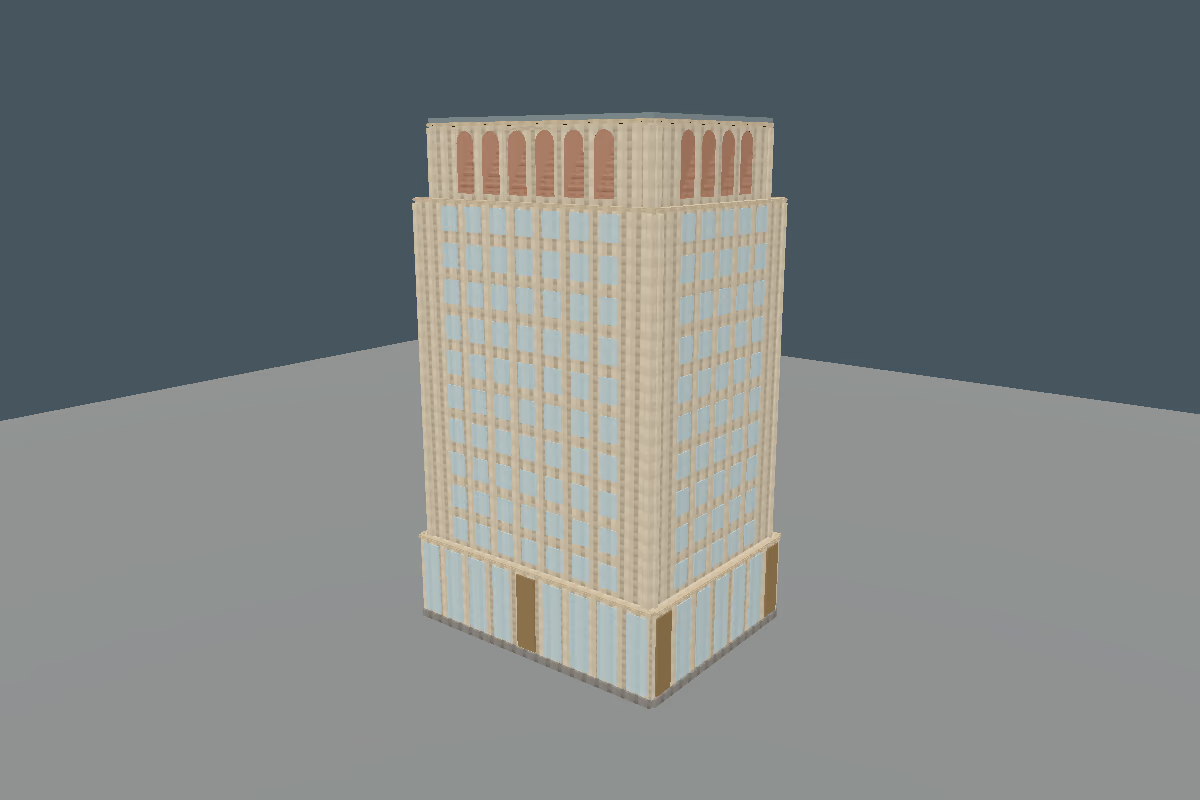
Every image identifies what it proves. Page screenshots demonstrate the published presentation only; generated inputs demonstrate asset channels only; canonical acceptance still requires render-target readback and a schema-v2 bundle.
1 published image
concept proxy preview
The complete SKILL.md as loaded by agents — verbatim, rendered.
Choose the compiler package before emission: a deterministic grammar produces
a validated plan, then emits material-slot BatchedMesh containers or merged
indexed BufferGeometry per building/chunk. Do not start from per-primitive
scene objects and try to recover semantics later.
Use the pinned Three.js r185 with WebGPURenderer from three/webgpu, TSL from
three/tsl, MeshStandardNodeMaterial / MeshPhysicalNodeMaterial material
identities, node post through RenderPipeline, and storage/compute APIs only
where they beat CPU chunking for city-scale state. Built-in node effects are
the first revision-matched comparison baseline; retain them only when their
measured quality and cost pass the workload contract.
settings + seed
-> mass grammar
-> plan validation
-> exposed-surface graph
-> facade / roof / trim placements
-> module registry validation
-> per-material-slot mesh compilation
-> one compiled building object or chunk batch
-> WebGPU/TSL materials and node pipeline integration
Read references/grammar-and-mesh-compiler.md before implementing the generator.
For generated terrain, islands, coasts, ruins, docks, boats, rocks, pebbles, flowers, or small scene assemblies, also read references/semantic-site-asset-kits.md. When any asset supplies collision, support, rigid-body, hydrostatic, structural, or interaction semantics, also apply the shared physics-domain and interaction contract.
Legacy implementation (deprecated, do not extend):
examples/authored-financial-tower/.
InstancedMesh soup of primitive boxes.BatchedMesh when many local module geometries share one material and
still need per-part visibility, transforms, sorting, or replacement. Use a
merged indexed BufferGeometry per slot when the building is static and
only chunk-level culling is needed.BatchedMesh loops one backend draw item per
visible multi-draw entry; it reduces scene-object/state management but does
not prove draw-call collapse. Merge compatible static slot geometry or
instance identical topology when fewer GPU draw items are required, and
record actual renderer/backend counts.InstancedMesh only for large counts of identical repeated objects
whose unique geometry count is small and whose per-instance identity is
meaningful. It is not the default compiler architecture for authored facades.Use the same plan-before-emission architecture for small site assets. The site plan consumes versioned terrain/coast fields plus a registry of semantic asset manifests; it emits placements with stable IDs, explicit anchors, support and exclusion volumes, material slots, LOD representations, and diagnostics. It does not infer meaning from arbitrary mesh bounds after placement.
Physics-facing manifests additionally publish stable ColliderProxy and, when
needed, DeformingSupportProxy IDs; PhysicsMaterialId bindings; provider IDs;
and versioned RigidBodyProperties or HydrostaticHullProperties. These proxy
identities and body properties are independent of render LOD, batching, and
runtime instance index. A display hull, building mesh, or bounding box is not a
collision, structural, buoyancy, or drag model.
Dynamic transforms publish RigidBodyState and view-independent
PresentedStatePair bindings with independent previous/current provenance and
leases. Cameras own render mapping through CameraViewPublication; per-view
LOD, visibility, shadows, caches, and resets belong to
ViewPreparationPublication. A sealed snapshot references candidate binding
IDs and leases, and multi-target FrameExecutionRecord entries retire those
leases only after every consumer completes.
Required reference families must resolve to a licensed compact asset kit or a tested procedural module/generator. A missing ruin, dock, boat, rock/reef, vegetation, cloud-silhouette, or other identity-bearing family is a blocker, not permission to fabricate boxes, billboard blobs, or unrelated noise.
environment snapshot + seed + authored anchors
-> candidate/support regions
-> constraint and clearance validation
-> deterministic asset/variant selection
-> semantic placements and adjacency/attachment graph
-> per-material/per-representation compilation
-> serialized site plan + runtime package
Place required landmarks and their reservations first, then dependent supports/attachments, then ecology, then optional filler clusters or decals. Every streamed phase uses stable candidate sorting and a conflict/filter halo; generation or chunk load order must not alter owned placements.
Required environment inputs declare units, sign, coordinate frame, filtering, revision, and missing-data behavior for terrain elevation/normal/slope, substrate and semantic regions, signed coast distance and coast frame, still-water depth or bathymetry where relevant, exposure, paths, and authored exclusions. Site assets consume dynamic water/motion hooks but do not solve them.
| Asset family | Required semantic contract | Causal owner outside this compiler |
|---|---|---|
| ruin/wall/foundation | module graph, corners/openings, support footprint, collapse state, material slots, vegetation sockets | low-level profiles/mesh writers route to geometry; materials route to procedural materials |
| dock/pier/bridge | land root, coast tangent/outward normal, deck datum, pile/bed contacts, berth/mooring frames, clearance prism | water surface/depth from water; optional motion from motion systems |
| boat/floating prop | hull/waterline frame, conservative swept bound, berth/free-water mode, material slots, RigidBodyProperties, HydrostaticHullProperties, stable collider/support proxy and wake/interaction emitter metadata |
buoyancy/wave/current state from water or domain solver; transform motion from motion systems |
| rock/boulder/pebble/debris | ground/embed anchor, support normal policy, footprint, cluster group, substrate/coast eligibility | topology from procedural geometry; PBR identity from procedural materials |
| flower/grass/shrub/tree | root anchor, ecology/species response, crown/wind bounds, clearance, growth/LOD package | placement/growth/wind from procedural vegetation |
Do not promote each pebble, flower, plank, or rubble fragment to a scene
object. Compile immutable identical topology through spatially paged instancing;
merge compatible static unique pieces by material slot; retain BatchedMesh
only when replacement, per-part visibility, or identity justifies its measured
r185 multi-draw entries. Authored landmark assets preserve individual IDs.
Choose the runtime package from mutability and visibility:
| Workload | Package | Visibility policy |
|---|---|---|
| One static close-inspection building | Merged indexed geometry per material slot | Object/part bounds; no runtime grammar work |
| Editable building with varied modules | BatchedMesh per compatible material family |
Per-object batch visibility and targeted replacement |
| Repeated identical modules | InstancedMesh or storage-instanced attributes |
Spatial pages; never one city-wide uncullable batch |
| Large district | Serialized spatial chunks with projected-error LOD and optional occlusion/compute compaction | Submit only visible chunks; impostor/proxy far field |
GPU visibility is justified only when its scan/compaction plus indirect draw actually removes more submission/vertex work than CPU chunk culling. Every LOD/packing transition uses the shared physical-pixel projected-error contract, including nearest support depth, unjittered projection, hysteresis/dwell, and simultaneous transition memory.
type BuildingQualityTier = "hero" | "city" | "distant";
function createBuildingPlan(settings: BuildingSettings): BuildingPlan;
function validateBuildingPlan(plan: BuildingPlan): BuildingDiagnostics;
function compileBuilding(
plan: BuildingPlan,
materials: BuildingNodeMaterials,
options: {
qualityTier: BuildingQualityTier;
chunkId?: string;
preferBatchedMesh?: boolean;
},
): CompiledBuilding;
function disposeCompiledBuilding(compiled: CompiledBuilding): void;
BuildingPlan stays serializable. It must include tiers, footprint pieces,
exposed intervals, placements, module usage, ownership rectangles, missing and
unused module IDs, overlap pairs, material slot counts, UV meters per repeat,
and per-slot triangle budgets.
Architecture generation is CPU deterministic; city-scale visibility, regeneration, LOD masks, and animated signs may use storage buffers or compute. Gate those paths once after renderer initialization:
import { WebGPURenderer } from "three/webgpu";
const renderer = new WebGPURenderer( { antialias: false } );
await renderer.init();
if (renderer.backend.isWebGPUBackend !== true) {
throw new Error(
'WebGPU is required for the canonical architecture compiler path; explicit fallback teaching belongs to threejs-compatibility-fallbacks.'
);
}
Quality tiers are asset and budget tiers:
hero:
full exposed-edge diagnostics, roofs, trim, ornaments, physical UV scale,
glass separated, close-inspection geometry
city:
same grammar and validation, fewer ornament rewrites, chunked material-slot
batches, coarser roof equipment, no tiny one-off geometry
distant:
serialized precompiled shells, simplified cornice/roof profiles, baked
color variation, no dynamic per-building recompute
MeshStandardNodeMaterial for masonry, metals, roof, and ornament;
use MeshPhysicalNodeMaterial for glass when transmission, IOR, thickness,
or clearcoat matters.SRGBColorSpace;
HDR/EXR radiance remains loader-declared linear. Normal, roughness,
metalness, masks, IDs, atlas selectors, and diagnostics use
NoColorSpace / linear data.HalfFloatType until tone mapping.RenderPipeline.outputColorTransform or an explicit renderOutput() node.
Materials and effects must not double-convert.pass(scene, camera), mrt() only when several nodes share scene data,
and PassNode.setResolutionScale() for reduced-resolution post effects.GTAONode for contact
grounding, BloomNode for authored emissive signs or interiors, TRAANode
for temporal anti-aliasing. Start shadows from an ordinary fitted directional
map; route CSM, tiled arrays, or caching through the shadow skill only when
coverage/error/invalidation and measured cost require them.Record a workload ledger for every compiled representation:
hero building:
semantic/material slots, V/T, projected facade/profile error,
compile p50/p95, peak transient bytes, draws after material batching
city block chunk:
source buildings, visible chunks/instances, submitted and culled V/T,
metadata bytes, CPU culling/submission or compute-compaction work IDs,
attachment/overdraw cost
StorageTexture: only for generated ID/LOD/debug masks that need textureStore()
site asset chunk:
accepted/rejected placements by constraint, stable asset/variant IDs,
anchor/clearance/support violations, visible/submitted instances and V/T,
material/representation buckets, transition overlap, metadata/asset bytes,
compile/upload/cull p50/p95 and composed paired-marginal evidence
distant skyline:
sector bounds, projected silhouette error, visible V/T, draws/material slots,
baked texture bytes and transition hysteresis
Chunk by spatial bounds before city-scale batching. Compute bounds after
compilation and after every regeneration. Pool reusable arrays and dispose
generated geometries, BatchedMesh objects, textures, and node effects when
replacing a district.
Allocate architecture cost from the complete frame and measure contemporaneous whole-frame and paired-marginal p50/p95 GPU time, CPU compile/cull/submission, overdraw, visible/culled triangles, upload traffic, peak resident/transient bytes, and sustained thermal behavior. Geometry/detail levels are selected by projected error and semantic requirements; no building/triangle/draw count is a portable device-class guarantee.
The generated building must survive:
A semantic site kit must additionally survive chunk-order permutations, terrain/coast revision invalidation, rotated coast-frame fixtures, missing asset and anchor failures, overlap/support/clearance assertions, LOD population and identity checks, waterline/deck/berth diagnostics, and low-end/mobile composed measurement. A visually plausible pile of untracked props is not an accepted site plan.
InstancedMesh placement as the default with
material-slot BatchedMesh or merged indexed BufferGeometry compilation,
because authored buildings need many module shapes, stable material
identities, exposed-edge ownership, and explicit mutability/culling policy.
Only merged static geometry or identical-topology instancing is presumed to
collapse r185 WebGPU draw items; BatchedMesh counts are measured.NodeMaterial
identities and node post, because the modern renderer path keeps materials,
post, color, and compute in one pipeline.Use $threejs-choose-skills for broad graphics preflight when the work spans
materials, shadows, post, validation, and city-scale performance.
Use $threejs-procedural-geometry for reusable profiles, sweeps, rings,
arches, frames, or low-level mesh writers without a building grammar.
Use $threejs-procedural-materials for procedural masonry, atlas filtering,
derivative normals, weathering, and per-slot material fields.
Use $threejs-procedural-fields for terrain/coast/support/exposure fields,
$threejs-procedural-vegetation for plant ecology and growth, and
$threejs-water-optics or $threejs-procedural-motion-systems for dynamic
water and transform state consumed by docks/boats. This compiler owns semantic
assembly, anchors, attachments, exclusions, stable asset selection, and the
site-plan package; it does not own water simulation, buoyancy physics, plant
growth, or generic rock mesh generation.
Structural deformation, fracture progression, collision resolution, rigid-body
dynamics, buoyancy, and fluid/structure coupling remain owned by the selected
external/domain solver. The site compiler serializes the canonical proxy,
property, provider, and adapter IDs; the solver participates in the shared
PhysicsGraph and exchanges canonical samples/interactions. Do not add a
site-local timestep, force accumulator, or mesh-bound collision callback.
Use $threejs-scalable-real-time-shadows for CSM/tiled shadow budgets and diagnostics.
Use $threejs-ambient-contact-shading,
$threejs-exposure-color-grading, and $threejs-image-pipeline for node
post stack ownership beyond architecture-specific guidance.
This skill owns massing, facade semantics, architectural modules, validation, and building-plan compilation.
Preserved concept proxies and generated-asset previews. They are excluded from primary completion counts and link to the canonical lab through the schema-v2 registry.