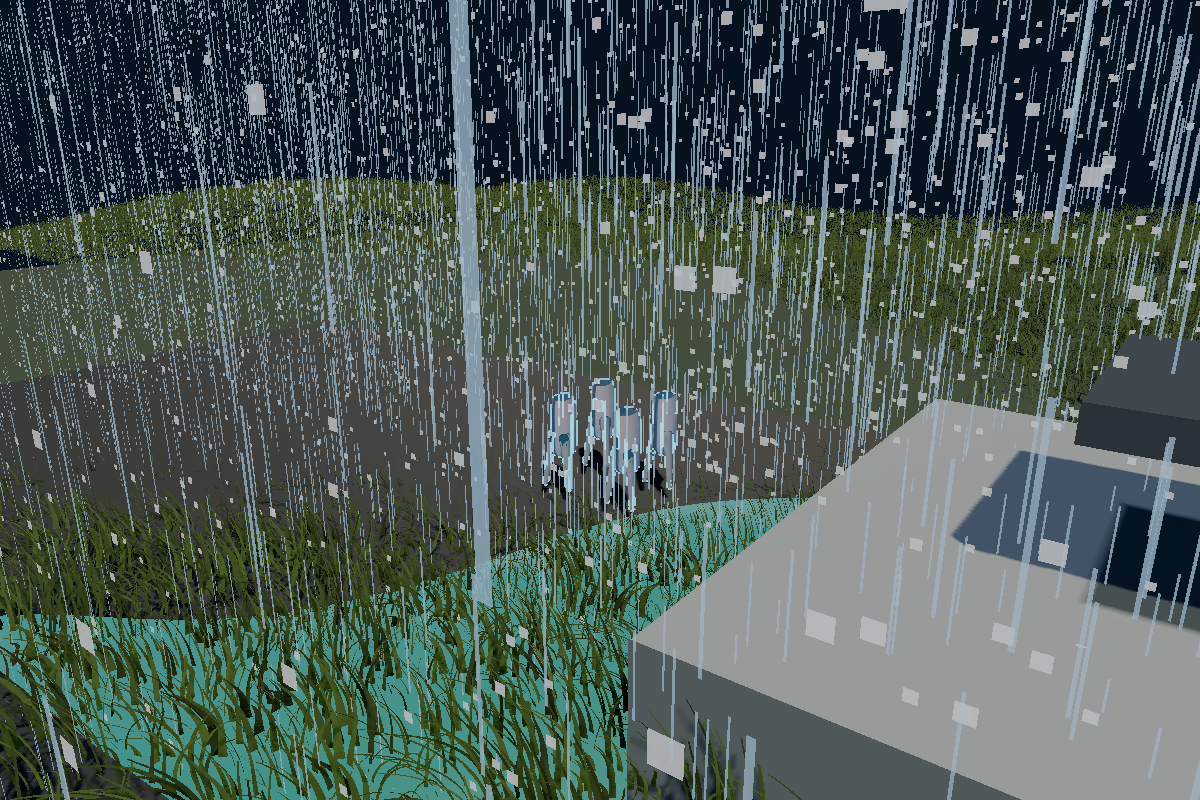
Live concept-proxy screenshot · not canonical evidence

Procedural Creatures

Build workload-selected procedural and generated creatures in Three.js r185 WebGPU/TSL. Use for spec-driven bodies, semantic rigs, field-extracted skinned reference meshes, diagnostic SDF shells, procedural gait/hop/flight/swim locomotion, support-relative foot planting, 2-bone IK, verlet appendages, repeated populations, deterministic creature labs, and genetic variation. Not for imported glTF skinned-clip pipelines.

$threejs-procedural-creatures 1 primary implementation 1 flagship 1 secondary surface native evidence pending Latest skill update commit 9077075 ↗ SKILL.md on GitHub ↗ raw (for agents) ↗

The approach, mathematically

A creature is a spec-driven body: primitives (tapered capsules, spheres) blended by smooth minimum into one signed distance field:

$$d = \operatorname{smin}_k(d_1, \dots, d_P), \qquad \operatorname{smin}_k(a,b) = \operatorname{mix}(a, b, h) - k\,h(1-h),\; h = \tfrac12 + \tfrac{a-b}{2k}$$

The interior gradient of a tapered capsule tilts with the taper slope $s = (r_b - r_a)/L$: $\nabla d = \hat{\mathbf q} - s\,\hat{\mathbf a}$, $\|\nabla d\| = \sqrt{1+s^2}$. Skin vertices snap to the iso-surface by Newton iteration with the full gradient norm:

$$\Delta\mathbf p = -\,\frac{(d - d_{iso})}{\|\nabla d\|^2}\,\nabla d$$

Locomotion is procedural: gait phase drives foot targets, 2-bone IK solves knees by the law of cosines $\cos\theta = \frac{a^2 + b^2 - c^2}{2ab}$, feet plant in world space, and verlet chains ($\mathbf x' = 2\mathbf x - \mathbf x_{prev} + \mathbf a\,dt^2$ + length constraints) animate tails and ears. Squash-and-stretch preserves volume: scale $(s, 1/\sqrt s, 1/\sqrt s)$ has determinant exactly 1.

Preview and evidence ledger

Every image identifies what it proves. Page screenshots demonstrate the published presentation only; generated inputs demonstrate asset channels only; canonical acceptance still requires render-target readback and a schema-v2 bundle.

Canonical runtime evidence pending1 published image

The full skill

The complete SKILL.md as loaded by agents — verbatim, rendered.

Procedural Creatures

Start with $threejs-choose-skills preflight when creatures live inside a larger scene stack. A creature here is an authored JSON spec compiled into a posed-primitive control rig. The skeleton is a semantic control rig (animation, IK, physical proxies, attachments), and its field is the generative surface source. The stable-topology default is a field-extracted reference mesh with skinning and optional bounded local correction; the per-slot snapped shell is diagnostic only. Distant bodies may use view-constrained impostors. No path raymarches the body. Pose is a compact primitive buffer sampled from an analytic clock, advanced by a local fixed-step solver only when recurrent state is standalone/authored, or advanced by its owning PhysicsGraphStage when recurrent state is cross-domain.

Read the shared physics-domain and interaction contract before habitat, support, water, contact, or cross-domain coupling. It defines the SI physics frame, gravity, clocks/ticks, scheduler, typed providers including the immutable EnvironmentForcingSnapshot, InteractionRecord, conservation groups, residency/state versions, and the immutable presentation publication chain. This skill consumes those boundaries; it does not fork them inside creature locomotion.

For plants and foliage use $threejs-procedural-vegetation. For generic transform timelines, springs, and staging use $threejs-procedural-motion-systems. Imported glTF skinned-clip pipelines (retargeting, animation blend trees, VAT crowds) are outside this pack — say so rather than stretching this skill over them.

Choose The Skin Representation First

Do not make every generated body pay for a live SDF evaluation. Choose from the update topology, projected error, and reuse count. Compute pixel error with the shared projected-error contract, including its unjittered projection and hysteresis rules.

Workload Representation Required proof
pose changes; surface connectivity does not one extracted reference mesh per compatible {compilerSignature, topologySignature, geometryDigest}, then skinning plus optional bounded local field correction topology validity, bidirectional surface error, skin-weight continuity, correction residual
geometry parameters change within a proven fixed-connectivity envelope the same extracted reference mesh, skinned and locally corrected signed-Jacobian/inversion and surface-error sweeps over the complete envelope
morphology can merge, split, open, or close components budgeted dynamic extraction, otherwise unsupported extraction cadence, transition policy, topology/event correctness, full mesh-validity gates
close deformation needs joint smoothing generated skinned mesh plus one bounded field correction correction residual and shadow/depth parity
many bodies share topology shared generated mesh/material, per-instance pose storage visible-instance submission, dirty upload bytes, and deformation error
projected body diameter is small orientation-aware impostor or aggressively simplified mesh silhouette error over the accepted view cone and transition hysteresis

The per-slot capsule shell that snaps every slot onto the union field is a preview/diagnostic representation only. It produces coincident or overlapping surface sheets at blends and cannot establish a manifold skin. The default stable-connectivity path extracts one reference mesh per compatible compiler, topology, and rest-geometry identity, skins it, and applies at most a bounded local field correction. Marching cubes, surface nets, and dual contouring are load-time choices: select by topology and feature requirements, validate the extracted surface, and never remesh at spawn. If the authored morphology changes connectivity, use a measured dynamic extractor or reject that operation explicitly.

Field-Driven Creature Architecture

The canonical renderer path is pinned Three.js r185 WebGPURenderer from three/webgpu, TSL from three/tsl, storage-buffer pose data, and node materials. Build in this order; every step ends in something renderable or assertable.

  1. Layering. Pure core (spec, field math, rig compiler, locomotion) with zero three imports; a Three/TSL adapter package; a thin scene adapter that only feeds world RigPose values; a standalone deterministic creature lab that imports the package and never the app.
  2. Spec. A creature is a small JSON CharacterSpec (~15–250 lines) of round primitives: tapered capsules, spheres, cones, verlet rope chains, IK leg parts. One validation gate; every error names part.field, because specs are meant to be generated, including by AI.
  3. Rig and blend compile. Parts map to primitive slots (capsule/cone/sphere = 1, rope = segments, leg = 2). The spec declares either an explicit blend tree/group graph with a symmetric k at every internal node or a validated order-independent n-ary kernel. Sorting part ids is not blend physics: renaming an id must not alter the surface, and permuting the input array must preserve both the compiled graph and field. Candidate programs retain every active leaf/subtree and blend ancestor, plus a saturation or tail certificate for every omitted sibling. A separate omitted color-weight bound is mandatory because geometric saturation does not bound the proximity-color kernel; rest-AABB overlap is only a conservative selector. Validate the bounded evaluation against the complete graph over the full pose/morphology envelope, including field, normal, and perceptual color error. Failed bounds raise K/rebuild or reject the tier; they never silently change grouping.
  4. Pose runtime. The runtime pose is a typed-array SoA buffer (a.xyz|ra, b.xyz|rb, k|rgb per slot), not object graphs re-copied into per-material vectors. Standalone/authored locomotion may advance on a local fixed-step accumulator (1/60 or 1/120, clamped input dt) and render interpolated pose — feet never pop on frame hitches. Cross-domain recurrent locomotion advances exclusively through its scheduled PhysicsGraphStage executions; only PhysicsGraph owns catch-up, drop, and discontinuity, and the render loop never steps that state. Root motion lives in the object transform; primitives stay creature-local; support-planted feet convert through the inverse root transform for body-frame IK, then write creature-local leg slots before storage upload and posed-bounds update. Maintain a real per-instance bounds from posed primitive AABBs. Prefer a conservative animation envelope for unchanged or analytic poses; refit only dirty or independently deforming instances. Never ship frustumCulled = false.
  5. Field. Tapered-capsule distance + pairwise polynomial smooth-min (Quilez form). Compute the analytic gradient fused into the same loop — per-primitive radial direction minus the cone taper term s·û, blended grad = mix(gradA, gradB, h) through each smin (the exact gradient of the polynomial smooth-min, not an approximation) — instead of 6-tap finite differences (a ~7× field-evaluation saving); keep central differences only as a CPU verification tap. PARITY CONTRACT: the CPU sampler and the TSL emitter implement the same formulas and change in the same commit.
  6. Surface. Extract and validate one reference mesh under an explicit component policy for each compatible {compilerSignature, topologySignature, geometryDigest}; compute semantic/geodesic or bounded-harmonic skin weights with contact barriers and a measured cap on normalized nonnegative influences. Use LBS only where a twist/volume sweep passes; use dual-quaternion or center-of-rotation skinning where LBS collapses joints, and gate their bulge/twist errors. A local Newton correction uses a curvature/edge-scale trust radius plus residual-decreasing backtracking; it rejects gradient degeneracy, triangle inversion, or failed descent. The acceptance sweep reports signed triangle area/Jacobian, inversion count, self-intersections, duplicate/coincident coverage, minimum angle, and bidirectional Hausdorff error. Store and transport a continuous radial frame from the rest mesh/skeleton; never choose a helper axis anew from the posed direction because the branch switch rotates theta discontinuously. The per-slot capsule shell remains a lab preview for field/candidate debugging, never the shipping topology.
  7. Rendering at scale. Share geometry only under a compatible {compilerSignature, topologySignature, geometryDigest, tier} mesh identity; a material may span mesh identities only when its graph/storage layout is identical. A biological/species label is not a batch key. Pose lives in storage (instancedArray / storage buffer) indexed by instanceIndex * maxParts + slot; evaluate the field over the bounded candidate set, with a dynamic loop bounded by the actual part count, never a masked full-budget unroll. Upload only active dirty pose ranges; coalesce writes and record bytes/frame instead of rewriting page-capacity storage by default. Cache material variants by {compilerSignature, topologySignature, tier, outline, debugMode, K}; scalar controls (ramp bands, roughness, outline width, sun, visualization range) stay uniform writes, never graph rebuilds.
  8. Shading. Select a diagnostic scalar view, illustrative ramp, or physically based surface from the output contract; toon is not the default for every scene. Corrected normals come from the final raw field gradient, normalized only for shading. Proximity-blended part identity may drive albedo/roughness or a scientific scalar palette. Optional field self-AO uses a measured number of taps and only describes intra-body occlusion. For toon hatching or paint-stroke stability that wants texture-space evaluation, treat a decoupled texture-space cache as an exception with an explicit UV, update, filtering, memory, and visible/shadow parity contract; it is not a default creature lighting cache. Prove shadow parity: the shadow/depth path must consume the same deformed position function, verified by a silhouette-vs-shadow test, not assumed. Decode authored sRGB colors to linear before any uniform/storage upload.
  9. Outline. For repeated populations, one post-process ID/normal edge pass over the whole population. The per-creature iso-offset back-face hull is a hero-shot variant only — it re-runs the entire snap per vertex and doubles draws.
  10. Locomotion when requested. Habitat selection, spawn placement, and route choice consume an injected, versioned world-field query with declared units, validity, and error; they never infer coast, substrate, slope, or water depth from rendered color or read a GPU render target back to the CPU. Reactive planted gait consumes an injected canonical SupportSurfaceProvider returning stable support/feature IDs, closest point, outward normal, and represented point velocity/acceleration; moving-frame angular kinematics come from its PhysicsFrameDescriptor. Plant feet in that moving support frame; this is kinematic support sampling, not a collision/contact impulse ABI; physical contacts use the shared contact record and InteractionRecord. Derive homes and swing arcs in its tangent plane, including slopes. Then use analytic 2-bone IK with a Gram-Schmidt bend hint; hopper state machine with volume-preserving squash (sxz = 1/sqrt(squash)); closed-form flight sampled from sim time; weather-responsive flight/appendages consume same-frame relative air velocity and density from a versioned EnvironmentForcingSnapshot graph edge, preserving channel time/support/filter/error and never owning private wind state; fixed-step verlet ropes; buoyancy response against the shared batched, channel-requested WaterSurfaceProvider. The canonical request uses physics-frame metres and carries context/provider/signal/schema IDs, requested PhysicsInstant, channel masks, footprint/filter, tolerances, staleness, acceptable residency/latency, and batch extent; descriptor discovery supplies a stable descriptor-table reference rather than a deep copy. Samples use freeSurfacePoint, freeSurfaceNormal, geometricNormalVelocityMps, surfacePointVelocityMps, materialCurrentVelocityMps, waterColumnDepthMeters, optional densityKgPerM3, and return the complete PhysicsSignalDescriptor, bundle sampleInstant, and per-channel actualPhysicsTime resolving to a PhysicsInstant. Requested and actual instants may differ only within declared latency/staleness gates. Each channel is the complete shared SampledChannel. geometricNormalVelocityMps is mandatory even when the parameterization- dependent full surfacePointVelocityMps is absent. Surface-point velocity and material current are distinct; unrepresented channels are absent, not zero, and a dependent tier is blocked rather than inventing them. Consumers do not subset, rename, or independently clock the shared envelope. An injected open-sea adapter may wrap threejs-spectral-ocean/examples/webgpu-fft-ocean/createCpuWaterHeightSampler(); a bounded-water adapter may wrap threejs-water-optics/examples/webgpu-bounded-water/createBoundedWaterHeightQuery() for its analytic component. The raw spectral sampler supplies truncation and per-sample inversion residuals; the provider adapter adds any measured floating-point/GPU-probe discrepancy or marks it unavailable. The bounded adapter reports analytic inversion/residual error plus either a proven live-grid residual bound, a converged surrogate error, or canonical typed absence classified unavailable. Missing error fields block locomotion tiers that require them. Creature locomotion never hides those errors behind frame-critical GPU readback. Rope-verlet writes its segment slots after base squash staging, after root-yaw target conversion, and after IK writes; the last stage touching a slot wins. Everything deterministic: seeded LCG + sim clock only — Math.random/Date.now/performance.now are banned in render code. A one-way creature/water route identifies the authoritative source and records a [G] upper bound on omitted creature-to-water feedback or explicitly narrows the claim/regime. If a creature participates in two-way water or contact physics, it emits source InteractionRecord entries and consumes reduced reaction records in the shared both-owner-predict/sample/load-scatter/water-advance/ reaction-reduce/correct/check/atomic-commit graph; local decals or ripple calls are not feedback. Coupling inside one state-equation owner may be explicit, semi-implicit, scheduler-bounded iterated, or monolithic; monolithic means that owner advances every coupled unknown. Any cross-owner route publishes SurfaceExchange with exact mode one-way, two-way-explicit, or two-way-iterated; it is never labelled monolithic. Its gather/scatter pair preserves zeroth/first moments and gates force, torque, interface work, and added-mass stability. Source/reaction records form an all-or-none InteractionReactionGroup; many-to-many reduction is legal and balance is tested in its declared frame/reference point. The accepted pose is contributed as a per-binding/provider PresentedStatePair to the view-independent PhysicsPresentationCandidate, which contains no camera or render transform. previousPresented and currentPresented each carry independent PresentationSampleProvenance, presentedInstant, state handle, and global spatial binding. The camera owner publishes CameraViewPublication, preparation owners publish ViewPreparationPublication, and the sealed PhysicsPresentationSnapshot references candidate binding IDs and lease refs. FrameExecutionRecord records multi-target execution and lease disposition keyed by lease ID. The presented states are not assumed solver n/n+1. Visible deformation, bounds, shadows, motion vectors, and temporal history resolve through this chain with separately tracked instants/frame/ transform/source epochs. Pose/topology/LOD/disocclusion history decisions are scoped ReactivePublication and ScopedResetAction records in ViewPreparationPublication, not extra pair or snapshot flags. Pose/topology/LOD/disocclusion changes contribute scoped reactive epochs and affected entities/regions for those per-view records.
  11. Boot. All heavy work is init-phase and budgeted. Only an immutable unit primitive template may be global; extracted connectivity, shell/reference mapping, transported radial frames, blend ancestry, candidate sets, and skin weights are mesh-identity-specific. Allocate fixed-size topology/tier instance pages, each bound to one compatible geometry identity, and add/recycle pages only at controlled lifetime boundaries—never resize one global population buffer. Time-slice compilation to the product's measured main-thread allowance or move it to a worker. await renderer.compileAsync(...) every shippable material/pass variant — display, depth/shadow, outline, configured MRT — behind the load screen using the owning scene/pass compilation API. Spawning a creature is validation plus an O(slots) buffer write; it never builds geometry, materials, or pipelines.
  12. Lab. A strict-port standalone lab app with a deterministic driver (seekTick(n) must equal stepTicks(n)), machine-readable telemetry, debug modes, foot-drift markers, and seed sweeps. Lab evidence proves the package, never the shipping scene.

Capability Gate

const renderer = new WebGPURenderer({ antialias: false });
await renderer.init();
if (!renderer.backend.isWebGPUBackend) {
  throw new Error('WebGPU backend unavailable for the canonical creature path.');
}

The following are authored preview-shell/local-correction starting points. An extracted shipping mesh selects density from projected error, deformation, and mesh-validity gates rather than inheriting these counts:

Tier Use for Preview shell Correction field trials Candidate K Normals Outline
Hero one or few close subjects 12 radial, 3 cap rings/slot 2 + residual early-out 8 analytic gradient, optional fragment-stage iso-offset hull or post edge
Repeated many visible bodies 10 radial, 2 cap rings 1–2 4–6 analytic gradient, vertex varying shared post edge pass
Distant small projected silhouettes 8 radial, 2 cap rings 1 2–4 analytic gradient, vertex varying none

If the user explicitly asks how to apply fallback when WebGPU is unavailable, route that teaching to ../threejs-compatibility-fallbacks/ instead of adding it here.

Performance Contract

Budget the population before styling it. The per-slot counts above describe the preview shell, not the extracted shipping mesh. Per-slot vertices (§5): V_slot = (2 + 2·capRings)·radialSegments + 2 (hero 98, repeated 62, distant 50). Per creature: V_shell = P · V_slot where P = compiled primitive count from the spec. For any field-corrected vertex, let S count correction trial field evaluations after the initial query, including rejected backtracking trials, and let K be candidate-leaf count. Then count fused evaluations exactly: E_snap = (S + 1)K, E_color ∈ {0,K} (reuse final distances or evaluate once), and E_AO = R K for R offset samples. Never multiply color or AO by the snap iteration count, and never use (S + 1)7P from a masked full-budget unroll with finite-difference normals. The forbidden-to-snap ratio is 7P/K at equal depth. Prove cost in the lab; do not copy population, slot, or millisecond constants from another fixture. Counts in the tier table are authored starting points, not device classes. Record the complete workload tuple {visibleInstances, topologySignatures, geometryDigests, pages, P, K, S, meshVertices, correctedVertices, influences, skinningMethod, shadowPasses, outlineMode, renderExtent, sampleCount} and report contemporaneous full-frame p50/p95 plus the paired marginal cost of enabling the bodies. Also record CPU fixed-step p50/p95, submitted draws, field evaluations, dirty upload bytes, peak live bytes, and thermal/sustained behavior on the named adapter. A tier passes only against the product's gated whole-frame CPU, GPU, memory, and presented-cadence budgets.

For constrained adapters, change representation before shaving constants. If the skin-only reference mesh passes projected/deformation error, remove live field correction, its candidate storage, and field self-AO entirely. If only a joint region needs correction, compare a correction-only mesh partition with a static per-vertex branch; accept the extra submission only when paired full- frame evidence beats divergent field work. Use an impostor only inside its silhouette/view-cone contract. Never select LBS as a cheaper tier where its twist/volume gate fails.

CPU side: rig update writes into a CPU Float32Array backing/staging store; that array is not a persistently mapped WebGPU buffer. Upload dirty page ranges through the Three.js storage-attribute update path. Require zero per-frame allocation; ordinary locomotion is O(slots) per creature per fixed step, while rope-verlet CPU cost is ropeSubsteps * ropeRelaxationPasses * ropeSegments, not O(slots). Static and closed-form poses must not be rewritten or integrated merely to exercise a compute path.

Batch habitat/support/water requests and interaction records as compact channel-masked SoA with generation-bearing identities distinct from population slots, bounded deterministic queues, and canonical batch-level InteractionBatchLedger records. Avoid per-creature query objects. Presented pose/resource generations use a frame-in-flight lease/reuse rule so compute or slot recycling cannot overwrite state still referenced by a sealed snapshot. Physical locomotion/interaction QualityTransition commits only at a scheduler tick with state projection, queue boundary, conserved-value/error ledger, atomic provider/identity generation, history action, rollback, and measured old/new peak residency. Visual mesh/LOD crossfades never duplicate an authoritative body or its reactions. Any physics-facing change to PhysicsQualityStateDescriptor.nativeStepAndCouplingControls, .stateVariablesAndInventories, .representedBandsFootprintsAndFilters, .stableIdPolicy, or .presentationRepresentation requires that exact QualityTransition; it maps every InteractionRecord.applicationLedgerKey and InteractionBatchLedger.exactOnceApplicationLedgerVersion, appears in PhysicsExecutionLedger, and publishes new versioned state only through PhysicsPresentationCandidate, CameraViewPublication, ViewPreparationPublication, and sealed PhysicsPresentationSnapshot. In-place mutation or an unledgered presentation crossfade is invalid.

Boot side: all shippable material variants compileAsync-warmed before reveal; build work is time-sliced to a declared main-thread gate or off-thread; capacity is a measured set of fixed topology/tier pages. Spawn is an O(slots) dirty write with zero geometry/material construction and zero pipeline compiles. Gate cold and first-visible frames separately from sustained frames; numeric limits come from the product contract and carry measured context.

Color And Output

  • Authored part colors are sRGB hex; decode to linear (c <= 0.04045 ? c/12.92 : ((c+0.055)/1.055)^2.4) before upload. Storage and uniform pose data is NoColorSpace linear data.
  • Genome/color mutation operates in perceptual space (OKLab/HSL on the sRGB hex), never on decoded linear floats.
  • The scene node pipeline owns tone mapping and output conversion; creature materials must not double-convert.

Reference

Read references/creature-body-systems.md for the exact build contract: spec schema, field formulas and constants, rig compiler rules, locomotion constants and gates, scale architecture, the surface-quality ladder, the creature-lab contract, the boot/compile/spawn contract, and the numeric gate table.

Diagnostic lab: examples/webgpu-procedural-creature-lab/. The lab currently provides a pure-core runtime, TSL adapter module boundaries, deterministic window.__lab browser surface, Playwright capture harness, numeric gates, and artifact gates for field math, snap residuals, preview-shell counts, locomotion, determinism, boot metrics, and capture manifests. Current caveat: the visible capture path is deterministic canvas evidence over the core and adapter contracts, not shipping-surface proof. Canonical closure requires a real WebGPURenderer reference-mesh path with proven skinning/local correction, mesh-validity gates, and visible/cast/received-shadow parity. The per-slot snapped shell remains diagnostic even after that closure.

Failure Conditions

  • the field is evaluated with masked full-budget unrolled loops over the slot budget instead of closed candidate subgraphs and a part-count loop;
  • a per-slot snapped capsule concatenation is shipped as a manifold body mesh;
  • field correction passes residual checks while triangles invert, self-intersect, duplicate coverage, or collapse below the declared minimum angle;
  • normals come from 6-tap finite differences in the shader when the analytic gradient is available in the same loop;
  • pose is per-creature material uniforms (one material per creature instead of per signature page), so compatible creatures cannot batch and every creature is its own draw call;
  • frustumCulled = false instead of per-instance posed bounds;
  • locomotion consumes raw render dt, so foot plants and hop phases pop under frame hitches;
  • cross-owner recurrent locomotion advances from a creature-local/render-loop accumulator, so it diverges from PhysicsGraph catch-up and exact-once interaction application;
  • part-id sorting defines a repeated smooth-min fold, so a rename changes the field, or candidate leaves are folded outside their declared blend ancestry;
  • proximity skin weights leak across contacting limbs, influences are not normalized after pruning, or LBS/DQ/CoR is chosen without bend/twist gates;
  • a helper-axis branch is recomputed from posed direction and flips radial surface coordinates;
  • gait assumes a static horizontal plane instead of querying the moving/sloped support frame;
  • habitat or spawn logic samples rendered albedo/noise, transient terrain LOD, or a frame-critical GPU readback instead of a versioned causal world query;
  • a swimmer treats wave phase/surface-height velocity as material current, or consumes an unlabelled velocity channel whose frame and meaning are undefined;
  • a missing WaterSurfaceSample channel follows the descriptor's explicit missingChannelPolicy (absent, reject, or a schema-named reconstruction policy); it is never silently zero-filled, and provider error/version is discarded, or a two-way creature bypasses InteractionRecord and its conservation group;
  • creature scale is multiplied into the shared gravity-provider acceleration while the SI metre/second contract remains fixed;
  • shadows silently use a different position path than the visible deformed surface;
  • visible pose, bounds, shadows, motion vectors, or temporal history consume different physics presentation snapshots, state versions, or origin epochs;
  • spawn/death, teleport, reparent, page-slot reuse, topology or LOD transition emits an extreme motion vector instead of an explicit history-invalid reason;
  • the outline doubles the full field-correction cost per body in a repeated-population scene;
  • debug/tier/band changes rebuild materials and meshes per creature instead of hitting a variant cache and uniforms;
  • geometry cache keys omit schema/compiler versions or rely on a 32-bit hash alone;
  • one resizable global population buffer replaces fixed topology/tier pages, or a CPU backing array is described as a persistently mapped GPU buffer;
  • sRGB hex is uploaded as-is (washed-out creatures) or decoded twice (dark creatures);
  • snap residual, stance drift, and CPU/GPU parity are eyeballed instead of gated numerically;
  • creature motion calls Math.random or wall-clock time anywhere in the render path.

Routing Boundary

Use $threejs-procedural-motion-systems for generic transform timelines, springs, staging, and rotating frames; this skill owns creature bodies, rigs, and creature locomotion. Terrain, planetary, and water skills own environment fields and their query error; this skill only consumes their support, habitat, and shared provider interfaces under the physics-domain and interaction contract. Use $threejs-procedural-geometry for general semantic mesh writers; this skill owns field-derived reference skins and its diagnostic shell. Use $threejs-procedural-vegetation for plants. Use $threejs-visual-validation for evidence bundles the creature lab emits. Imported skinned-asset character pipelines (glTF clips, retargeting, VAT crowds) are an explicit gap in this pack — do not stretch this skill over them.