Primary target surface
This non-rendering suite is generated from canonical fixtures. Acceptance comes from deterministic route verdicts and negative controls, not GPU readback.
Diagnose unexpected Three.js WebGPU/TSL runtime, rendering, API, asset, or version behavior. Use for a concrete failure, a suspected upstream regression or known issue, or a choice among an application fix, released upgrade, bounded workaround, upstream report, and blocker.
Image: Deterministic contract-lab screenshot. Source lab: debugging-contract-lab.
This non-rendering suite is generated from canonical fixtures. Acceptance comes from deterministic route verdicts and negative controls, not GPU readback.
Source hashes, claim verdicts, promoted same-lab media, fixed routes, exact tier contracts, and current limitations.
Only schema-v2 labs with accepted runtime and evidence contracts appear here. Other source directories remain visible through the demo registry without being promoted to runnable proof.
Every image identifies what it proves. This skill owns a non-rendering scenario suite, so acceptance depends on deterministic fixture verdicts, ownership and budget checks, and mutations rather than GPU pixels.
1 published image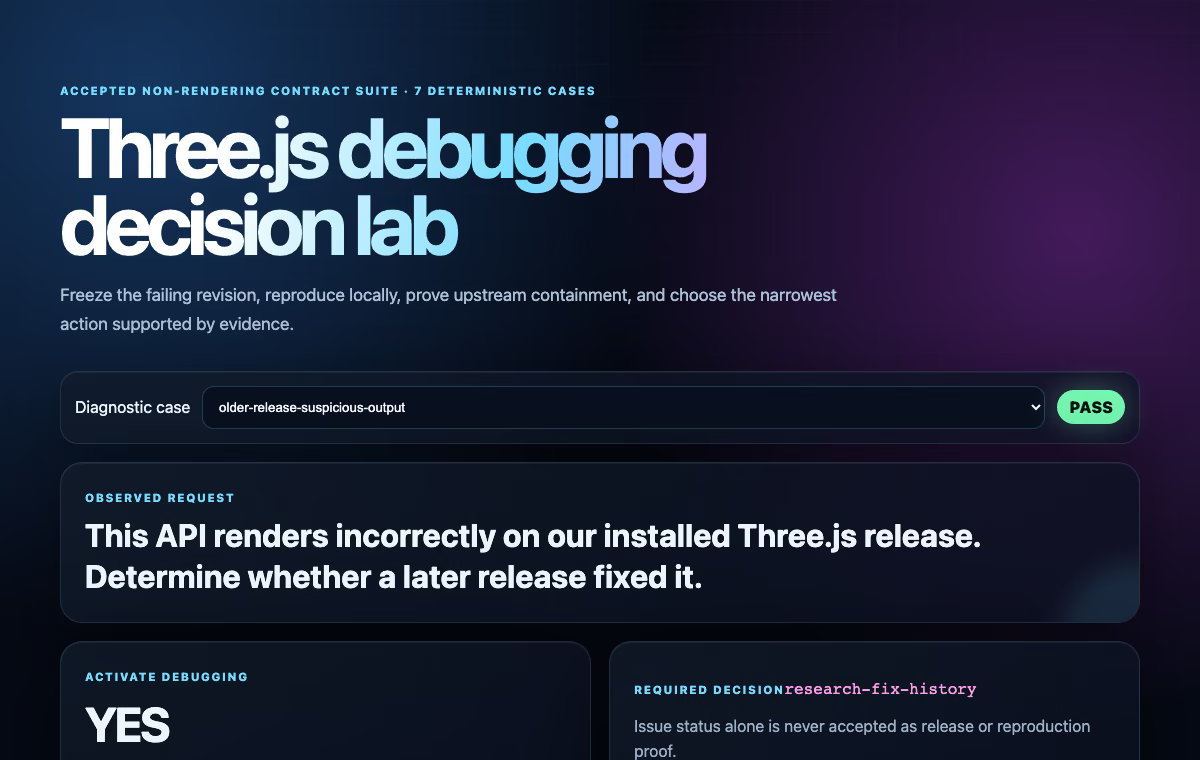
The complete SKILL.md as loaded by agents, rendered verbatim.
Reproduce first. Treat installed source and official history as evidence, not as
background trivia. A domain skill defines the intended mechanism;
$threejs-visual-validation supplies formal image, timing, resource, or
regression proof when the diagnosis needs it.
Keep one case record with the symptom, expected behavior, exact environment, minimal reproduction, first failed contract, local evidence, upstream candidates, constant version matrix, conclusion, action, and limits. Record unknown values as unknown.
Record every environment fact that can affect the failure: resolved package
version, runtime THREE.REVISION, lockfile resolution, import entrypoints,
browser/OS, seed, asset revisions, and exact command or interaction. For a
rendering or backend claim, also record renderer class, initialized backend,
GPU, and relevant capabilities. Build the smallest deterministic reproduction
that still fails.
A conclusion about the canonical WebGPU path requires an initialized
WebGPURenderer with renderer.backend.isWebGPUBackend === true. Otherwise
record that claim's blocker; reach $threejs-compatibility-fallbacks only when
the user explicitly requests that branch. Do not impose a renderer or backend
gate on a non-rendering API, export, asset, or version conclusion.
This step is complete when the relevant environment truth is recorded, the reproduction fails repeatedly under that environment, and another run can distinguish reproduced from not reproduced.
Separate API semantics, numerical invariants, render-state invariants, resource transitions, and visual expectations. Identify the earliest failing assertion, frame, pass, draw, dispatch, resource transition, or diagnostic—not merely the final symptom.
This step is complete when one observable boundary divides the last known-good state from the first bad state.
Remove unrelated systems while preserving the suspect API, material, geometry path, backend, projection, precision, ownership, and lifecycle behavior. At a cross-system boundary preserve the same units, frames/origin, owner, interval/cadence/sample phase, state identity, validity/staleness/error, reset, and completion semantics.
A different renderer, material, or representation may localize the fault; it cannot prove the original path correct.
This step is complete when every remaining component participates in the first failure and the suspected mechanism is still the one under test.
Inspect the installed export map, source, types, tests, examples, and migration material for the resolved revision. Test local hypotheses first: application misuse, stale or duplicate imports, migration changes, missing renderer initialization, unsupported backend/capability, invalid data, duplicate output conversion, lifecycle/synchronization error, and third-party integration.
This step is complete when each plausible local hypothesis has an executable result or an explicit missing-evidence record.
Research upstream only when local evidence does not settle the cause, installed source and current documentation disagree, a version-dependent regression or upgrade is plausible, or the user asks about known issues. Read upstream research before searching and follow its primary-source order.
Classify every candidate independently:
| Classification | Required proof |
|---|---|
usage-or-integration-error |
installed contract explains the failure and the local correction passes |
intentional-api-change |
official migration or source history proves a deliberate change |
upstream-active |
current checked code reproduces and an upstream record matches |
fixed-unreleased |
the matching fix is merged and checked publication/package contents show it is not yet shipped, as of the recorded check time |
fixed-released |
a published package contains the fix and the same reproduction passes |
not-reproduced |
the candidate configuration does not reproduce the local failure |
unrelated |
API, backend, symptom, affected range, or reproduction differs materially |
insufficient-evidence |
reproduction, containment, fix, or release proof is missing |
Closed is not a classification, and merged is not evidence that an npm release
contains the fix. An unavailable registry, uninspected package, or unknown
publication state is insufficient-evidence, not fixed-unreleased. Record
the check time and versions inspected for a publication claim. A passing
candidate configuration does not prove the original failure resolved unless
the reproduction and relevant environment remain comparable.
This step is complete when every inspected candidate has exactly one supported classification.
When the diagnosis depends on version behavior, change one Three.js version at a time while holding the reproduction, backend, browser/GPU, imports, assets, and assertion constant. As evidence permits, record the installed version, last known good, first bad, fixing commit, first published fixed release, and current checked release.
This step is complete when every conclusion about affected range or release availability follows from comparable rows rather than version labels.
First identify the narrowest containment that protects the violated invariant. Then verify the proposed correction on the original reproduction. Recommend an upgrade only after proving the fixing commit, the first published package that contains it, and a passing reproduction on that package.
Choose one action:
This step is complete when the chosen action has a passing or falsifiable verification, names its version/backend scope and side effects, and does not claim more than the evidence supports.
Return the root cause, installed result, relevant upstream issue/PR and fixing commit, affected range, first published fixed release, classification, fixed version result, regression assertion, one decision, and limitations.
Stop when one conclusion has direct local evidence and, when upstream is involved, direct primary-source/release proof. Also stop when all plausible candidates are classified and the exact missing evidence is explicit. Do not collect unrelated issue IDs after the action is settled.